What if the biggest risk in your hydrogen project isn’t technology, cost, or even electricity prices – but the design decisions you’re making today?
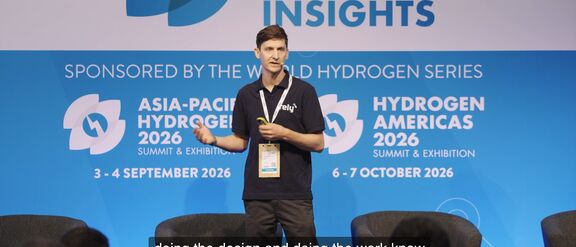
At a time when the green hydrogen industry is under intense cost pressure, short-term trade-offs are inevitable. But as Evert Vanderhaegen, O&M Manager at Rely, argues, those trade-offs can become long-term regrets if we don’t design with lifetime value in mind.

“We are all making compromises today. The key is to make sure we don’t regret them over the entire operational life of the project.”
Lesson #1: Think Long-Term – But Go Beyond CAPEX
The industry often relies on LCOH to guide decision-making – and rightly so. But too often, optimization stops at surface-level trade-offs.
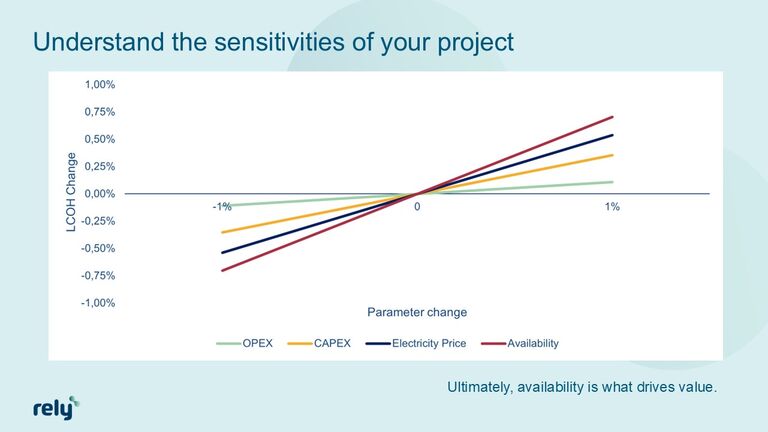
A striking insight challenges conventional thinking: “It’s not CapEx that’s king; it’s availability.” Small design decisions – like how equipment is arranged or accessed – can significantly impact maintenance, downtime, and ultimately hydrogen output.
Take containerization. While it reduces CapEx and accelerates deployment, poor implementation can create maintenance bottlenecks, increasing downtime and operational costs. The result? A design that looked efficient on paper may actually increase LCOH over time. At Rely, we consciously integrate these considerations upfront, ensuring that design choices deliver not just initial savings, but sustained operational value.
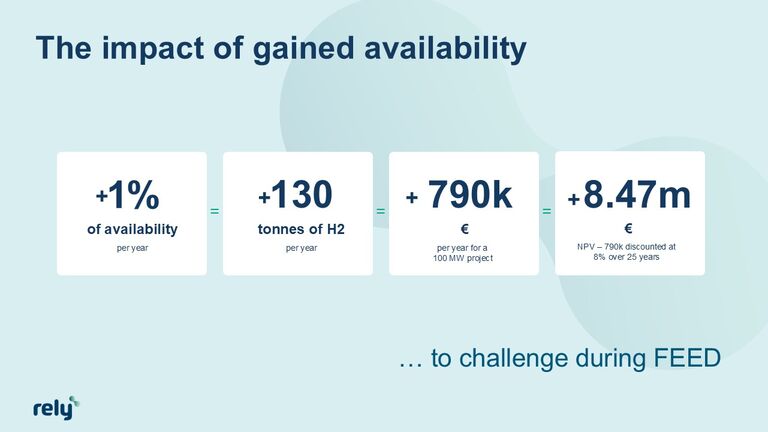
Every gain counts. In a 100MW plant, getting 1% more of availability can result in approx. 130 additional tons of hydrogen per year, meaning close to €800,000 annual revenue increase. That’s the equivalent of €8.5 million in CapEx value.
“If you can gain 1% availability for less than €8.5 million, it’s worth it.”
This underscores the importance for design teams to understand how changes in availability, performance, OpEx, and CapEx impact LCOH – so they can quickly assess and prioritize the ideas that truly create value.
Lesson #2: Like Romans, Design for Maintenance, Not Just Performance
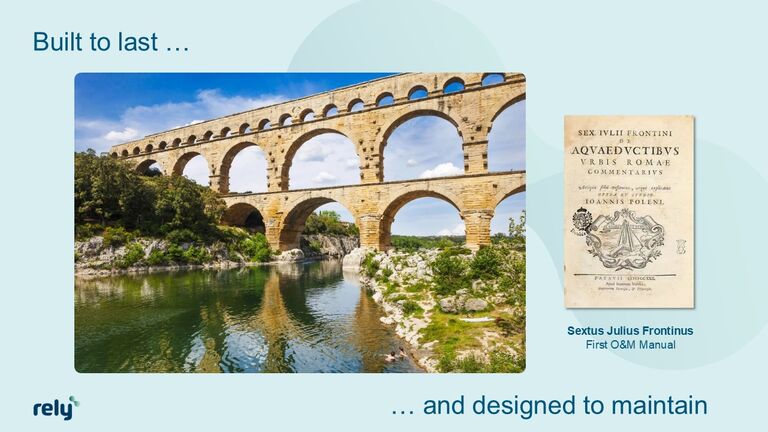
To truly optimize lifetime value, maintenance must be integrated into design – not treated as an afterthought. The inspiration? Roman aqueducts.
What could they teach us about green hydrogen? Built 2,000 years ago, the Roman aqueducts were not only durable; they were designed to be maintained, with access points for inspection, sediment traps (early filtration systems), bypass systems enabling continuous operation, and built-in redundancy for critical supply.
“Thinking long-term is not enough. You must design for maintenance.”
Applied to modern electrolysis systems, this means:
- Ensuring easy access to critical components
- Designing for online maintenance whenever possible
- Leveraging modularity intelligently and standardizing spare parts across modules
In a design-for-maintenance mindset, Reliability, Availability, and Maintainability (RAMS) is a powerful tool. Yet too often, it is only used to confirm inherent availability – when it should instead be applied dynamically throughout the engineering phases to actively drive design decisions.
"Use RAMS as a design driving tool."
At Rely, this philosophy translates into layouts where maintenance is anticipated, facilitated, and optimized from day one.
Lesson #3: Put Skin in the Game – Align Incentives Through Contracts
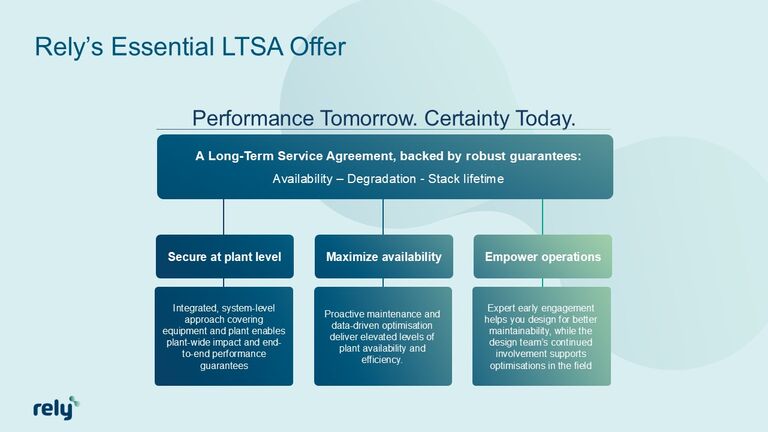
But even the best design can fall short without the right operational framework. The Romans understood this well: maintenance contractors were engaged on multi-year contracts with strong accountability, even putting personal assets at stake. The modern equivalent? Well-structured Long-Term Service Agreements (LTSAs).
But here lies a critical challenge: Two LTSAs with the same price can mean completely different things. Differences in scope, guarantees, and definitions – especially around availability – make comparisons difficult and often misleading.
To truly de-risk projects:
- Contracts must be fully transparent and comparable
- Guarantees must reflect real operational conditions
- Providers must be accountable for long-term performance
At Rely, this approach translates into integrated, plant-level commitments with clear guarantees on availability, degradation, and stack lifetime.
“At Rely, we design performance for tomorrow - but we deliver certainty today through our LTSA.”
Conclusions: Shift your Mindset Before It’s Too Late
As the green hydrogen industry scales, the successful projects will not simply be those who minimize upfront costs – but those who maximize lifetime value.
That requires a fundamental shift:
- From CapEx-first to availability-first thinking: quantify what truly drives your project’s value – and design for it.
- From design-for-delivery to design-for-operations: modularize intelligently, ensure accessibility of critical components, and design with maintenance in mind.
- From fragmented responsibilities to aligned incentives: properly evaluate LTSA's and ensure contractors have skin in the game.
“Availability is a key driver of value. If you don’t design for it from day one, you’ll pay for it every day after.”
The energy transition is not just about building faster or cheaper; it’s about building smarter, for the long run. With Rely, we design for the performance of tomorrow, and provide certainty today through our LTSAs.
"Availability is king. Performance is queen. CapEx comes in third."
Interested in knowing more?
Expert insight: making availability bankable
Hear Evert Vanderhaegen, our Head of Operations & Maintenance, explain this article in the full presentation from World Hydrogen Summit Rotterdam.